
Sterling Strategic

The oversight layer for custody, tokenization, insurance, lending, and supply-chain settlement.

Sterling Strategic is the governance and orchestration layer that connects disconnected systems — custody, underwriting, lending, logistics, and ERP data — into auditable workflows. Powered by StratChain™, our settlement and verification infrastructure for real-world assets, title control, collateral delivery, and financial execution.

The next wave of infrastructure won’t be optional — it will be required.

HOW WE SERVE

STERLING STRATEGIC — OVERSIGHT LAYER

Rules • Routing • Compliance • Enforcement

Approve • Deny • Escalate • Verify

Status & Alerts
Live system health & risk signals
Execution Console
Human-in-the-loop approvals
Routing Engine
Policy-based transaction flow
Audit Monitor
Immutable oversight & logs

CUSTODY & TOKENIZATION

Coinbase

Regulated digital asset custody

Fireblocks

MPC wallets & transaction security

BitGo

Institutional custody & controls

Anchorage

Federally chartered crypto bank

INSURANCE & RISK

Lloyd’s

Underwriting & risk transfer

Aon

Risk structuring & advisory

Munich RE

Reinsurance capital backing

Allianz

Global coverage & guarantees

LENDING & CAPITAL

Apollo

Private credit & structured capital

Silvergate

Real-time settlement rails

Railsbank

Banking-as-a-service APIs

SUPPLY CHAIN

Maersk

Global freight & ports

Evergreen

Ocean shipping & routing

FedEx

Last-mile & express logistics

ERP Backbone

Systems of record & reconciliation

REAL-WORLD EXECUTION

Assets • Inventory • Payments • Ports • Verification

Retail & Individuals
Understanding Digital Asset Systems — Without Assumptions
A guided walkthrough for individuals who are intelligent, thoughtful, and cautious — but unfamiliar with how these systems actually work.
Retail & Individual Walkthrough
Clarity before commitment. Structure before action.
Think in Terms You Already Know
  • Banking systems
    Accounts, transfers, and balances are recorded by institutions.
  • Asset ownership
    Who owns what is defined by records, not physical possession.
  • Settlement
    Time delays exist because systems must reconcile.
  • Record-keeping
    Trust depends on who controls the ledger.
Why Digital Asset Systems Exist
  • Shared records
    Multiple parties reference the same source of truth.
  • Fewer intermediaries
    Less manual reconciliation.
  • Clear ownership
    Verification is built into the system.
  • Faster settlement
    Transfers occur with fewer dependencies.
Technology Does Not Remove Risk
  • No guaranteed outcomes
    Markets still move in cycles.
  • No replacement for planning
    Structure matters more than access.
  • Human behavior remains
    Decisions still drive results.
How Individuals Use These Systems
  • Long-term exposure
    As an alternative asset class.
  • Strategic allocation
    Measured, staged decisions.
  • Balance-sheet awareness
    Assets considered alongside liabilities.
Sterling Strategic’s Role
  1. Clarify how these systems fit into your financial picture
  2. Align exposure with goals and tolerance
  3. Prevent reactive or uninformed decisions

Get Started — Retail / Individual

Begin your intake to explore compliant, structured access to Sterling Strategic services.

Small & Mid-Size Businesses (SMB)
Operational Clarity Without Enterprise Overhead
Helping growing businesses understand where digital systems improve control, cash flow, and decision-making — without disruption.
Small & Mid-Size Business Walkthrough
Structure, oversight, and scalability — without enterprise complexity.
The Pressure SMBs Are Under
  • Growth without visibility
    Operations scale faster than reporting and controls.
  • Disconnected systems
    Accounting, vendors, logistics, and banking do not align.
  • Cash flow uncertainty
    Timing gaps create operational stress.
What Digital Infrastructure Changes
  • Shared operational data
    Teams reference the same source of truth.
  • Clear transaction records
    Movement of value is traceable.
  • Reduced reconciliation
    Less manual cleanup after the fact.
Risk Does Not Disappear — It Becomes Manageable
  • No speculation required
    Systems focus on process, not price.
  • Controls before expansion
    Structure scales with growth.
  • Decision accountability
    Actions are documented and reviewable.
Where SMBs Apply These Systems
  • Vendor and payment coordination
    Reduced timing friction.
  • Operational reporting
    Clearer insight into activity.
  • Capital readiness
    Cleaner records support financing discussions.
Sterling Strategic’s Role
  1. Assess operational gaps
  2. Map digital infrastructure to real workflows
  3. Stage adoption without disruption

Next Steps — Small & Mid-Size Business

Complete your intake to evaluate capital, risk, and settlement pathways.

Enterprise & Institutional - Grade Infrastructure
Governance, Oversight, and Institutional Control
Helping institutions evaluate digital infrastructure through risk, compliance, and operational accountability.
Enterprise & Institutional Walkthrough
Governance, compliance, and scalable oversight.
Institutional Starting Point
  • Governance first
    Authority, approval, and accountability precede deployment.
  • Evidence-based decisions
    Every action must be reviewable and defensible.
  • Risk classification
    Operational, legal, and counterparty risks are isolated.
What Institutions Are Solving For
  • Settlement clarity
    Reduced reconciliation and timing uncertainty.
  • Custody controls
    Separation of duties and access governance.
  • Regulatory durability
    Systems designed to withstand scrutiny.
Why Adoption Is Staged
  • Pilot exposure
    Controlled environments before scale.
  • Monitoring maturity
    Oversight evolves alongside exposure.
  • Policy alignment
    Technology follows governance, not the reverse.
Sterling Strategic’s Role
  1. Assess institutional readiness
  2. Map governance and control requirements
  3. Design staged, auditable adoption

Enterprise Engagement

Enterprise engagements begin with a strategic consultation.

Digital Settlement Layer
Modernizing How Value Actually Moves
Settlement is the invisible backbone of finance. Digital settlement focuses on accuracy, timing, and transparency — not speculation.
Digital Settlement Walkthrough
How transactions finalize — and where traditional systems fall short.
What Settlement Actually Is
  • Agreement vs completion
    A trade is not finished when it is agreed — it is finished when ownership changes.
  • Multiple intermediaries
    Clearing, reconciliation, and confirmation sit between parties.
  • Time delays
    Settlement can take days, even when decisions are instant.
Where Traditional Settlement Breaks Down
  • Manual reconciliation
    Teams resolve mismatches after the fact.
  • Data inconsistency
    Each system maintains its own version of events.
  • Hidden risk
    Counterparty exposure exists until settlement completes.
What Digital Settlement Changes
  • Shared records
    All parties reference the same transaction state.
  • Near-instant finality
    Ownership updates occur as transactions execute.
  • Reduced exposure
    Less time between commitment and completion.
Practical Applications
  • Asset transfers
    Clear ownership changes without reconciliation lag.
  • Cross-border activity
    Fewer handoffs between systems and jurisdictions.
  • Operational clarity
    Teams know exactly where transactions stand.
Sterling Strategic’s Role
  1. Evaluate settlement friction and risk
  2. Map digital settlement to existing workflows
  3. Support controlled, compliant adoption

Digital Settlement Services

Initiate your digital settlement intake or speak with our team.

StratChain™
Smart Contracts & Operational Transparency
Turning fragmented processes into verifiable, coordinated execution across systems and partners.
StratChain™ Walkthrough
Shared truth, enforceable rules, and operational clarity.
The Core Problem: Systems Don’t Agree
  • Siloed data
    Procurement, logistics, finance, and compliance maintain conflicting records.
  • Manual reconciliation
    Disputes are resolved after cost and delay occur.
  • Late enforcement
    Rules are applied inconsistently or too late to prevent loss.
What Smart Contracts Actually Do
  • Codify rules
    Business logic executes automatically and consistently.
  • Create shared checkpoints
    Events are recorded once and referenced everywhere.
  • Reduce ambiguity
    Conditions are explicit, not interpreted differently by each party.
A Practical Example: Tariffs & Country of Origin
  • Unknown melt or pour data
    Defaults trigger higher or blanket tariffs.
  • Disconnected updates
    Supplier changes are not visible across systems.
  • Cost impact
    Lack of transparency directly increases landed cost.
Why Organizations Deploy StratChain™
  • Earlier risk detection
    Issues surface before becoming losses.
  • Stronger compliance posture
    Controls are embedded, not retrofitted.
  • Scalable governance
    Rules evolve without rebuilding infrastructure.
Sterling Strategic’s Role
  1. Identify transparency and coordination gaps
  2. Design smart contract guardrails aligned to policy
  3. Integrate without disrupting existing systems
  4. Stage adoption with measurable outcomes

StratChain Advisory Access

StratChain services are consultative and initiated by direct discussion.

Credit & Liquidity Layer — Capital & Lending Partners
Modern Infrastructure for Credit, Risk, and Transparency
Helping lenders, private capital, and financial partners gain clearer visibility into assets, cash flow, and enforceable structures.
Capital & Lending Partner Walkthrough
Transparency, enforceability, and informed underwriting.
The Core Challenge in Modern Lending
  • Opaque asset data
    Collateral and cash flows are difficult to verify in real time.
  • Fragmented reporting
    Financials, operations, and compliance live in separate systems.
  • Delayed risk signals
    Issues surface after exposure is already established.
What Digital Infrastructure Changes
  • Verifiable records
    Transactions and obligations are traceable.
  • Shared reference points
    Borrowers and lenders view the same data.
  • Clear enforcement logic
    Conditions are defined and consistently applied.
Risk Is Structured — Not Eliminated
  • No speculative dependency
    Systems focus on process, not asset price movement.
  • Earlier intervention
    Triggers highlight issues before defaults occur.
  • Clear accountability
    Actions and deviations are recorded.
Where Lenders Apply These Systems
  • Asset-backed lending
    Improved collateral visibility.
  • Structured finance
    Clear covenant monitoring.
  • Private credit
    Better alignment between capital and operations.
Sterling Strategic’s Role
  1. Map operational and financial transparency gaps
  2. Design enforceable digital structures
  3. Align reporting with underwriting needs
  4. Support staged implementation

Lending Capital Partners

Submit partner intake information to initiate review.

Risk & Insurance Layers — Insurance Partners
Risk Visibility, Verifiable Coverage, Enforceable Structures
Helping insurers assess, price, and monitor risk using transparent operational and asset data — not assumptions.
Insurance Partner Walkthrough
Risk assessment, underwriting clarity, and enforceable controls.
The Insurance Visibility Problem
  • Static disclosures
    Risk is assessed at onboarding, not continuously.
  • Limited operational insight
    Policies rely on self-reported controls.
  • Delayed loss discovery
    Issues surface after claims events.
What Digital Infrastructure Enables
  • Continuous verification
    Controls and activities are observable.
  • Event traceability
    Incidents are timestamped and attributable.
  • Clear exposure mapping
    Risk aligns to real operational behavior.
Underwriting Becomes Dynamic
  • Pricing reflects behavior
    Risk-adjusted coverage evolves over time.
  • Fewer disputes
    Claims reference shared records.
  • Clear compliance posture
    Controls are provable, not implied.
Where Insurers Apply These Systems
  • Asset-backed coverage
    Verified collateral and custody.
  • Operational risk policies
    Monitoring of real-world activity.
  • Specialty and emerging risk
    Coverage where traditional data is weak.
Sterling Strategic’s Role
  1. Translate operational data into insurable signals
  2. Design enforceable digital guardrails
  3. Support compliant integration with existing policy frameworks

Insurance Partners

Begin insurance partner onboarding through the intake form.

STERLING STRATEGIC — OVERSIGHT LAYER

Rules • Routing • Compliance • Enforcement

Approve • Deny • Escalate • Verify

Status & Alerts
Live system health & risk signals
Execution Console
Human-in-the-loop approvals
Routing Engine
Policy-based transaction flow
Audit Monitor
Immutable oversight & logs

CUSTODY & TOKENIZATION

Coinbase

Regulated digital asset custody

Fireblocks

MPC wallets & transaction security

BitGo

Institutional custody & controls

Anchorage

Federally chartered crypto bank

INSURANCE & RISK

Lloyd’s

Underwriting & risk transfer

Aon

Risk structuring & advisory

Munich RE

Reinsurance capital backing

Allianz

Global coverage & guarantees

LENDING & CAPITAL

Apollo

Private credit & structured capital

Silvergate

Real-time settlement rails

Railsbank

Banking-as-a-service APIs

SUPPLY CHAIN

Maersk

Global freight & ports

Evergreen

Ocean shipping & routing

FedEx

Last-mile & express logistics

ERP Backbone

Systems of record & reconciliation

REAL-WORLD EXECUTION

Assets • Inventory • Payments • Ports • Verification

Dashboard Intelligence

A unified rules engine powering every product tier.

Dynamic rule sets trigger based on permissions, collateral, and compliance thresholds.
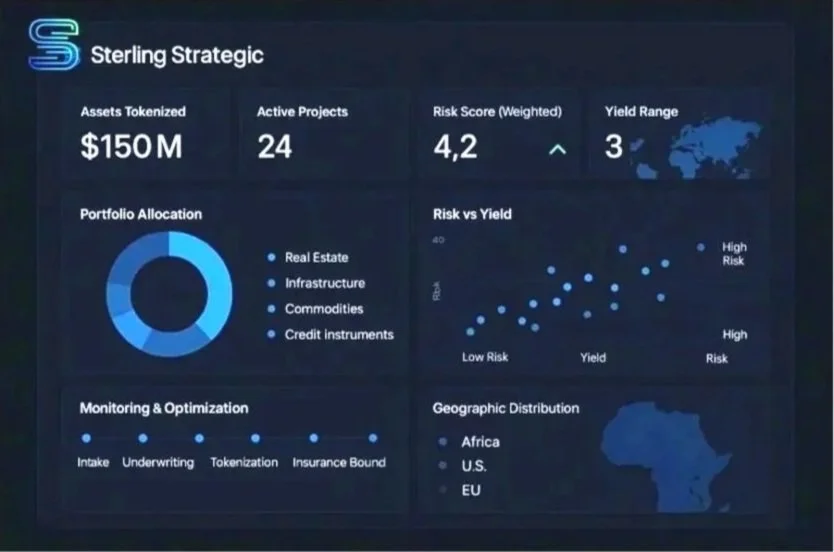
Command Center UI
Live status, alerts, routing & controls
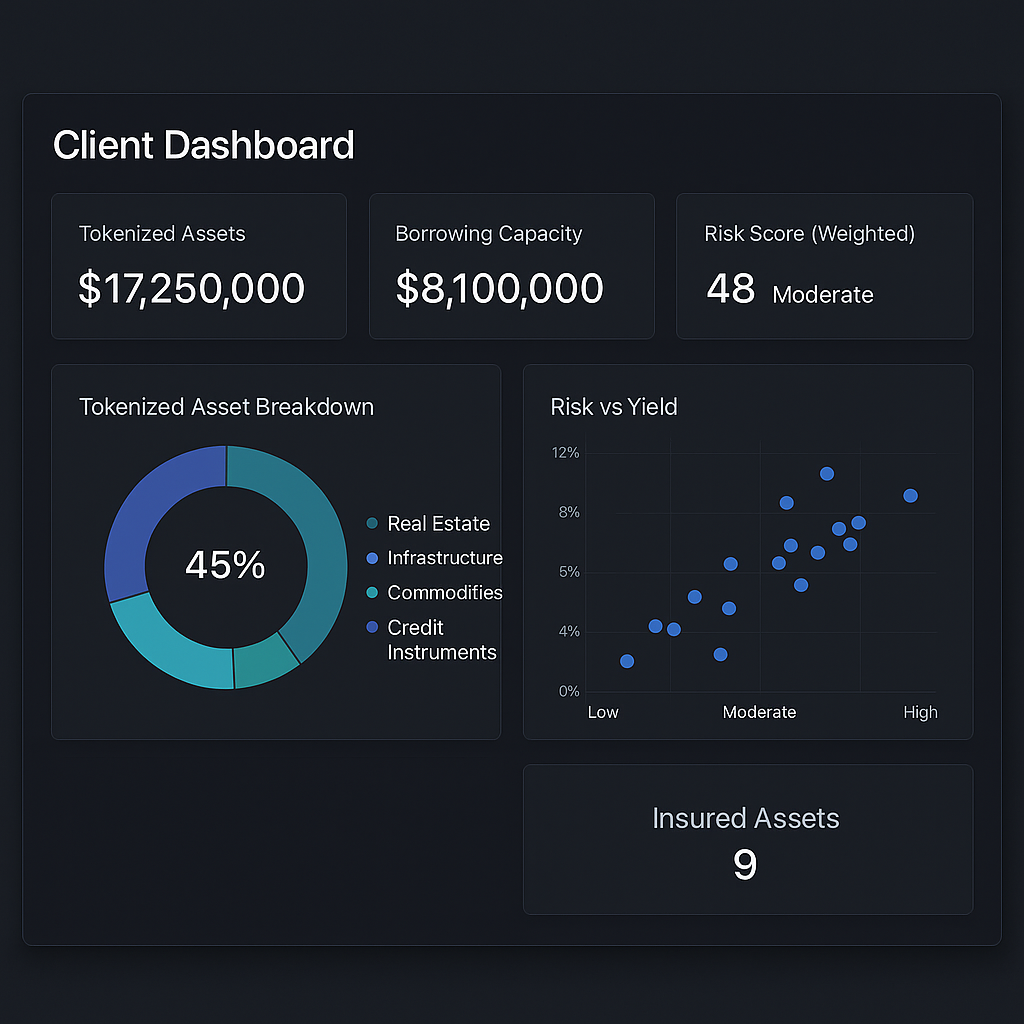
Risk & Volatility Layers
Thresholds, exposure & scenario flags
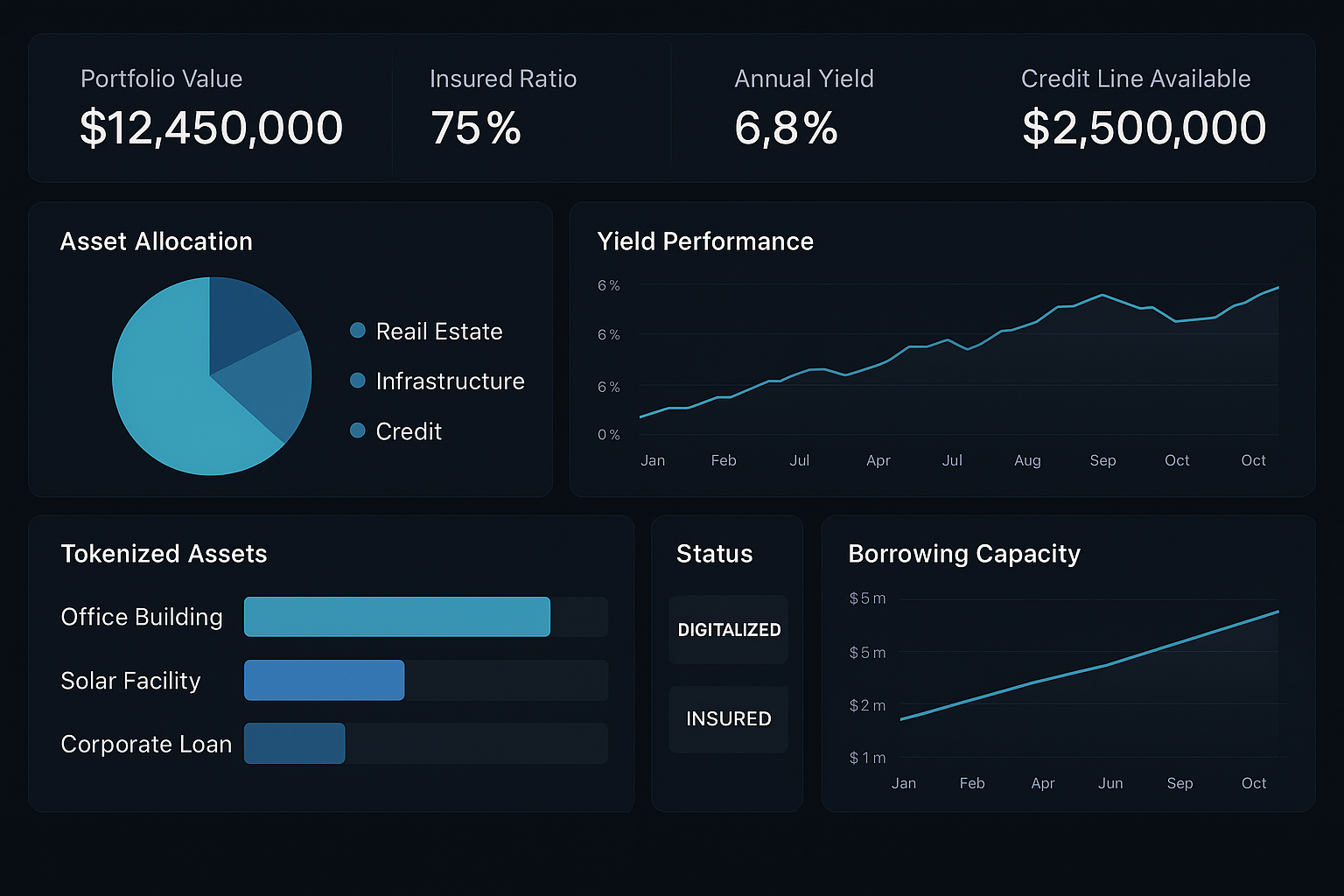
Amortization & Routing
Yield paths, constraints & logic